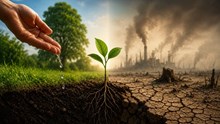





When a flood swallows a village or a drought empties its wells, the response is familiar: trucks arrive with bottled water, sacks of grain follow, and tents go up on higher ground. But relief addresses the symptoms, not the underlying cause. The land that flooded once may flood again, and the wells that ran dry may run dry again. The challenge runs deeper - in the health of the soil and in the way water moves through it.
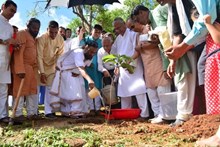
This is where permaculture, essentially a farming technique, can become a form of humanitarian work. The term, a blend of ‘permanent’ and ‘agriculture’, has evolved to mean a permanent culture: a way of designing homes, farms and communities to work with nature, rather than against it. It supports communities to move beyond emergency relief, helping them build resilience, dignity, and self-reliance. At The Art of Living in Bengaluru, a seven-acre stretch of barren, rocky land was transformed within months into a productive farm using raised beds, rainwater swales and careful, patient planting.
Gurudev Sri Sri Ravi Shankar, the founder of the Art of Living and a global humanitarian, speaks of the earth as a living system of which we are a part. “The earth is a living organism,” he says, sustained by and sustaining the life around it. He describes it as conscious, linking the health of the earth directly to human well-being.
That interdependence begins with food security. Permaculture encourages communities to grow diverse, nutritious food using the resources their local land and climate can sustain. Dependence on external supply chains, by contrast, can leave farmers vulnerable when a season fails. A farmer who buys the same seed every season and relies on one crop for income, has little cushion when that crop fails. More than 30 lakh Indian farmers have learnt through The Art Of Living’s farming programmes to work with their soil, nurture it, and protect its long-term productivity rather than exhaust it.
Water follows food closely, because in droughts and floods, the two crises are often interconnected. Permaculture focuses on rainwater harvesting, restoring soil, and conserving water through small-scale measures. These steps help capture every drop of rainwater before it runs off and is lost. By holding water this way, communities can better withstand the next dry spell or heavy storm. They absorb the shock rather than simply endure it.
Aid can only be a temporary bridge. Permaculture offers something more lasting: the knowledge to build a sustainable livelihood from the land itself. The shift is visible. More than 2000 families have benefited directly through dedicated permaculture programs. In villages once caught in cycles of debt, farmers who once borrowed heavily for chemical fertilisers and pesticides are now reducing those costs. Many of them sell directly through the Art of Living’s Kisan Manch platform, helping them secure better prices for their produce. For them, it is more than higher income, it is a path from debt to dignity.
At the heart of it all is climate resilience. Healthy soil, biodiversity, and thriving local ecosystems let a community withstand a failed monsoon or a harsh heat wave. And unlike emergency aid, this knowledge does not leave when the relief workers do. It stays with the community.
People are no longer recipients of help. They become empowered to rebuild their own environment. They restore their land, strengthen their livelihoods, and in the process reclaim their sense of agency.
“Agriculture is the backbone of human existence,” Gurudev reminds us, but no civilization can prosper if farming itself is unsustainable. That is why he urges everyone to learn about permaculture, seeing it not merely as a farming practice, but as a life skill for the future.
For a humanitarian organisation, this makes permaculture more than an agricultural technique; it becomes a model of regenerative humanitarianism. The shift is from receiving aid to generating the means to prosper. Food, water, and livelihoods come together here, pointing towards something larger: human dignity. The question is no longer simply how people survive a crisis, but how they become resilient enough to thrive beyond it.
There is a deeper philosophical connection. Humanitarianism is, at its core, about caring for human life. Permaculture extends that ethic to the systems that sustain it - soil, water, plants, animals, and communities.
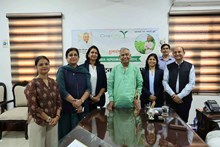
That shift takes a practical shape this month on August 22 and 23, when The Art of Living hosts its first National Conference on Permaculture and Sustainability, bringing together hands-on sessions that go beyond lectures to focus on actionable learning.
As the world marks Humanitarian Day, the message is clear: true humanitarian work does not end with relief after a drought or a flood. It begins in the soil, grows through the seasons, and sustains generations to come.