




There is a Sanatan concept - Pancha Mahabhuta - the five great elements: Prithvi (Earth), Jal (Water), Agni (Fire), Vayu (Air), and Akasha (Space). Rooted in Vedic thought and embraced across Hindu, Buddhist, and Jain traditions alike, this philosophy holds that all living beings - including the human body - are composed of these five elements. Their balance sustains life. Their disruption ends it.
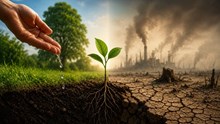
Of these five, Soil - the earth beneath our feet - is the one we are killing.
Not slowly. Not accidentally. Deliberately, systematically, and without pause.
Soil feeds every civilisation that has ever stood. Every culture that has ever cooked a meal, grown a crop, buried its dead, and called a place home - did so because soil allowed it. It is not a backdrop to human history. It is the author of it.
And we are tearing out its pages.
In the rush of modern agriculture, in the blind hunger of industrial greed, in the comfortable negligence of policy rooms and boardrooms, we have done to soil what no drought, no flood, and no ice age ever managed - we have stripped it of its life, poisoned its chemistry, and erased in decades what nature spent a thousand years building.
This is not an environmental think-piece.
This is a reckoning.
And it begins right beneath where you are standing - beneath the same earth that Hindu philosophy has revered as Bhoomi Mata, Mother Earth, for thousands of years.
How Humanity Turned its Most Vital Resource into Rubble
Every second, the equivalent of four football fields of healthy soil becomes degraded somewhere on Earth. Multiply that by the minutes in a day, the days in a year -and the numbers become almost too large to absorb.
According to the UN Convention to Combat Desertification (UNCCD), at least 100 million hectares of healthy land is being lost every year, with degradation accelerating across Africa, Asia, and Latin America. The UNCCD's first-ever Data Dashboard, compiled from 126 countries, confirmed in 2023 that land degradation is advancing at an astonishing rate across all regions.
The Annual Review of Environment and Resources (2024), drawing on peer-reviewed literature ahead of FAO's second comprehensive global soil assessment, puts it plainly: most of the world's soil resources are in only fair, poor, or very poor condition, and conditions are getting worse in more cases than they are improving. A total of 33% of all soils are moderately to highly degraded as a result of erosion, loss of organic matter, poor nutrient balance, salinization and alkalinization, contamination, acidification, loss of biodiversity, sealing, compaction, and poor water status.
The consequences are now spilling beyond farmlands. Approximately 1.7 billion people live in areas where crop yields are falling because of human-induced land degradation -a pervasive and silent crisis that is undermining agricultural productivity and threatening ecosystem health. This is the headline from FAO's State of Food and Agriculture (SOFA) 2025 report -arguably the most comprehensive land degradation analysis ever conducted.
And if we do nothing? Projections backed by the Global Environment Facility (GEF) suggest that up to 95% of the Earth's land surface could be degraded by 2050.
India: A Nation Standing on Crumbling Ground
For a country of 1.4 billion people -soon to be 1.7 billion by 2050 -India's soil crisis deserves front-page coverage every single day. It does not get it.
National Bureau of Soil Survey and Land Use Planning data shows that 146.8 million hectares, or around 30% of the soil in India, is degraded. India's own Agriculture Minister Shivraj Singh Chouhan acknowledged this at a global soil conference in November 2024, calling for immediate measures. He pointed out that India produces over 330 million tonnes of foodgrains annually and exports agricultural products worth $50 billion -and yet, it is imperative to address the pressing concerns surrounding soil health.
The numbers from ground surveys are deeply unsettling. India's soil organic carbon (SOC) levels have dropped from 1% to just 0.3% in the past 70 years. In Punjab, only 6.9% of soils had high organic carbon, and this number went down further in 2024–25.
The Desertification and Land Degradation Atlas of India (SAC 2021) puts the current extent of degraded land at approximately 97.85 million hectares, representing nearly 30% of the country's geographical area. The Desertification and Land Degradation Atlas 2023 notes that erosion alone causes the loss of about 15 tonnes of topsoil per hectare annually translating to an economic loss exceeding Rs 50,000 crore every year.
According to the 2019-20 Soil Health Survey, 55% of India's soil is deficient in nitrogen, 42% in phosphorus, and 44% in organic carbon. Faced with depleted soils and mounting pressure to produce, farmers are left with little choice but to reach for chemical fertilisers - not out of ignorance, but out of necessity. India's current NPK (Nitrogen-Phosphorus-Potassium) ratio stands at 7.7:3.1:1 -in stark contrast to the ideal 4:2:1 -reflecting a severe nutrient imbalance in agricultural soils. This over-reliance on nitrogen-based fertilizers, coupled with insufficient use of phosphorus, potassium, micronutrients, and organic manure, has triggered a vicious cycle of declining soil productivity.
This is the Green Revolution's unacknowledged bill, now coming due.
The human story behind the statistics is equally troubling. A farmer in Vidisha, Madhya Pradesh, cultivating soybean on 10 acres, followed every modern recommendation -quality seeds, fertilisers, irrigation -yet his fields produced a robust 15 quintals per hectare in 2020, but by 2024, this had dropped to just 11 quintals per hectare, even after using high-quality seeds, fertilizers, and irrigation. His story is replicated in thousands of villages across the country.
What Exactly Are We Destroying?
Soil is not dirt. This is the first misconception that needs to be buried.
A single handful of healthy soil contains more living organisms than there are people on Earth -bacteria, fungi, protozoa, nematodes, earthworms, and countless other microorganisms that form an invisible ecosystem of extraordinary complexity. These organisms drive nutrient cycling, decompose organic matter, fix nitrogen, suppress plant disease, and regulate water movement. They are, quite literally, the engine of terrestrial life.
Research published in PNAS (2025) through a global meta-analysis confirms that warming significantly reduces bacterial and fungal diversity, with effects particularly strong under extended warming durations and in nutrient-poor soils. This decline in microbial diversity compromises soil ecosystem functioning, including the capacity to sequester soil organic carbon (SOC), potentially creating a feedback loop that further accelerates warming.
This feedback loop is what should keep scientists and policymakers up at night. Soil is the planet's largest terrestrial carbon sink -it stores more carbon than all the world's plants and the atmosphere combined. When soil degrades, it releases that stored carbon as CO₂, accelerating climate change, which then further degrades soil. A study cited by Carbon Brief (2025) suggests that restoring just 50% of degraded croplands globally could prevent more than 20 billion tonnes of CO₂ equivalent emissions by 2050 -equivalent to five times the annual emissions from the entire land-use sector.
The threats are multiple and compounding: water erosion strips the topsoil that took centuries to form; salinisation from unscientific irrigation turns fields into salt flats; industrial and urban waste pours heavy metals -lead, cadmium, arsenic -into farmlands; excessive tillage breaks up soil structure; and monoculture farming leaves soil biologically exhausted.
Global South Bears the Brunt
While soil degradation is a universal problem, its weight falls most heavily on nations that can least afford it.
Around 30% of the world's soils are moderately to highly degraded. Forty percent of these degraded soils are located in Africa, and most of the rest are in areas afflicted by poverty and food insecurity.
In 2024, the FAO reported that approximately 75% of soils in Latin America and the Caribbean are facing degradation issues, posing significant threats to food security and potentially resulting in economic losses estimated at USD 60 billion annually.
China's northern plains face a double crisis -groundwater depletion and flood risk driven by soil compaction and agricultural stress, with the first aquifer already depleted and the second nearing exhaustion. In South Asia, erratic monsoons and rising temperatures are compounding what was already a man-made disaster.
Land degradation typically results from a combination of factors, including natural drivers such as soil erosion and salinization. However, human activities such as deforestation, overgrazing, and unsustainable irrigation practices are now among the leading contributors.
The World Economic Forum's Global Risks Report 2025 identifies water supply shortages as the top environmental risk for India and the world over the next two years -a risk that is inseparable from the state of our soils, since healthy soil is what absorbs rainfall, recharges aquifers, and prevents floods.
The Policy Gap: Well-Intentioned, Poorly Executed
Governments are not blind to the crisis. The architecture of policy responses exists -the problem is in their reach and rigour.
India's Soil Health Card Scheme, launched in 2015, has distributed over 23.5 crore cards, providing farmers with crop and soil-specific recommendations based on laboratory testing. The scheme has yielded notable results, including a 5–6% increase in crop yields. But adoption of the scheme's recommendations remains inconsistent, and millions of farmers still lack access to real-time soil quality data.
At the international level, the UNCCD COP16 in Riyadh (2024) delivered a decision to encourage countries to avoid, reduce, and reverse soil degradation of agricultural lands. The resulting Riyadh Action Agenda aspires to conserve and restore 1.5 billion hectares of degraded land globally by 2030. The Riyadh Global Drought Resilience Partnership pledged $12 billion towards land restoration initiatives. These are significant commitments -but aspirations and appropriations are very different things.
FAO's SOFA 2025 calls for integrated land-use strategies and policy interventions -including regulatory measures like deforestation controls, incentive-based programs, and cross-compliance mechanisms that link subsidies to environmental outcomes. It also highlights that policies must be tailored to farm structure, since smallholders face distinct financial constraints compared to large operations.
Meanwhile, India allocates one-ninth of its total agricultural budget to fertiliser subsidies -overwhelmingly directed at urea -while investment in soil restoration and sustainable practice adoption remains comparatively modest.
What Hope Looks Like
The science is clear that restoration is possible. It is slow, but it is real.
Reversing just 10% of human-induced degradation on existing croplands -for example by adopting sustainable land management practices such as crop rotations and cover cropping to preserve soil health, reduce erosion, and contribute to biodiversity -could restore enough production to feed an additional 154 million people every year.
Regenerative agriculture -cover cropping, composting, no-till or reduced-till farming, agroforestry, integrated nutrient management -is not a utopian fantasy. Farmers in Brazil and Argentina have demonstrated it at scale. Research published in 2024 found that maize income rose by $200 per hectare in systems where rotation included annual crops, with soybean income increasing by $128 per hectare under similar conditions.
India's own Paramparagat Krishi Vikas Yojana (PKVY) promotes organic farming at the cluster level. The Zero Budget Natural Farming (ZBNF) movement has shown results in Andhra Pradesh. The National Mission for Sustainable Agriculture (NMSA) provides the policy backbone. What is missing is not the framework -it is the urgency, the enforcement, and the farmer-centred implementation.
The Clock is Not Waiting
Here is the fundamental reality that political speeches, agricultural conferences, and policy discussions have yet to address with the seriousness it truly deserves:
Soil is not a renewable resource on any human timescale. It takes between 500 and 1,000 years for nature to build just one inch of topsoil. We are losing what took millennia to form -in a single generation, through choices we make every day.
The food on your plate, the water in your glass, the air filtered through plant roots embedded in the ground - all of it traces back to the health of the soil. When we poison it with unchecked chemicals, compact it with heavy machinery, strip it bare through deforestation, or drown it in untreated industrial waste, we are not just damaging farmland. We are dismantling the biological infrastructure that makes human civilisation possible.
Governments must go beyond distributing soil health cards and link agricultural subsidies directly to sustainable practice adoption. Chemical fertiliser policy must be restructured to incentivise balance rather than excess. Urban planning must stop treating agricultural land as a default site for expansion. And every citizen -not just farmers -must understand that the relationship between their food choices, their consumption habits, and the health of the earth beneath them is direct, not abstract.
The Pancha Mahabhuta did not become sacred by accident. Our ancestors - who walked barefoot on this earth, who offered the first grain back to the soil before eating it themselves, who named this ground ‘Bhoomi Mata’ and meant every word - understood what modern policy is only beginning to rediscover: the earth is not a resource. It is a relationship. When one element falls out of balance, all others follow. Soil is falling. But it has not fallen yet. And that distinction - between falling and fallen - is where hope lives.
The Vedic tradition did not just describe the five elements. It prescribed a duty toward them. Dharma toward the Earth is not a metaphor - it is instruction. Every farmer who chooses compost over chemicals is performing an act of devotion. Every citizen who demands better soil policy is honouring an obligation older than any government. Soil can heal. It has done so before, across civilisations that chose wisely at the last moment.
The earth gave us everything. It is asking for very little in return. It is asking us to stop - and to choose differently, before the option is no longer ours to make.
References:
FAO SOFA 2025, UNCCD Data Dashboard 2023–24, Annual Review of Environment and Resources 2024, National Bureau of Soil Survey and Land Use Planning (India), Desertification and Land Degradation Atlas of India (SAC 2021), ICAR, Soil Atlas 2024 (Heinrich-Böll-Stiftung), PNAS Global Meta-Analysis 2025, Carbon Brief 2025, World Economic Forum Global Risks Report 2025, Frontiers in Environmental Science 2025