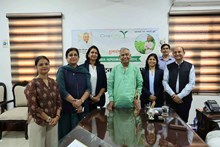





CropLife India has submitted recommendations to the Ministry of Agriculture and Farmers Welfare on the Draft Pesticides Management Bill, 2025, saying the proposed law is a timely and much-needed reform, but requires targeted changes to ensure Indian farmers get faster access to safer and more effective crop protection technologies.
The association represents 17 R&D-driven crop science companies that account for around 70% of India's crop protection market and are responsible for introducing nearly 95% of the molecules in the country.
India's pesticide regulatory framework continues to be anchored in the Insecticides Act, 1968, even as farming realities have changed sharply. Indian agriculture faces annual crop losses of 10 to 35% due to pests and diseases, translating into economic losses of over ₹2 lakh crore. Yet farmers continue to depend heavily on molecules introduced three to four decades ago, even as climate variability, rising resistance and changing pest behaviour increase pressure on farm productivity.
A central concern in the submission is that the current draft does not address the policy gap contributing to this innovation lag. When farmers remain dependent on older chemistries for too long, resistance builds faster, spray intensity rises, and it becomes harder to meet tightening residue expectations in domestic and export markets. Newer crop protection technologies are more targeted, lower-dose and better aligned to evolving pest pressures, yet their introduction in India is often delayed.
Bringing a new molecule or new use to India requires major investment in safety, efficacy, residue and environmental data. Without a clear framework governing how that data is used, there is limited incentive to introduce newer technologies early in the Indian market. The association has therefore proposed a limited, time-bound PRD framework of about five years from first registration, which would create a more predictable pathway for newer solutions to reach farmers faster, while allowing competition through independent data generation. The logic has previously been examined by the Satwant Reddy Committee, reflected in the Pesticides Management Bill, 2008, and endorsed by the Parliamentary Standing Committee on Agriculture and the Committee on Doubling Farmers' Income.
This matters beyond innovation alone. Stricter residue norms in markets such as the EU are already pressuring Indian exports. Industry bodies in Assam have flagged that nearly 40 million kilograms of premium tea exports to Europe and the UK are exposed to tighter residue requirements.
Commenting on the recommendations, Mr. Ankur Aggarwal, Chairman, CropLife India and Executive Chairman & Managing Director, Crystal Crop Protection Ltd., said, “The government's effort to modernise pesticide regulation is timely and welcome. The draft Bill takes several important steps in the right direction, including digitisation and stronger action against spurious products. But farmers today are dealing with more erratic pest pressures in the field, while exporters face tighter residue and SPS requirements in key markets such as the EU and UK. We cannot expect Indian agriculture to respond to these challenges with older chemistries alone. The final law must keep regulation science-based and time-bound, act firmly against illegal trade, and create a credible pathway for newer, safer and more effective crop protection technologies to reach farmers faster.”
The submission flags the unchecked growth of online sale as one of the most serious emerging threats to genuine pesticides. Under the existing framework, e-commerce platforms are not explicitly required to obtain licences, verify Principal Certificates of sellers, or ensure that sales stay within approved geographic areas. The absence of platform-level accountability creates a regulatory gap through which unauthorised and spurious products are reaching farmers. CropLife India has called for explicit statutory obligations on platforms, including licence and Principal Certificate verification, product traceability, territorial compliance and notice-and-takedown responsibilities, to be written into the Bill.
On offences by companies, the association has flagged that the current draft allows Directors and senior officials with no operational role in an alleged contravention to still be prosecuted indiscriminately. Such prosecutions harass professionals, dissuade talent from taking up senior positions, and undermine the very objective of decriminalisation. CropLife India has recommended that only nominated responsible persons in-charge of the specific facility, storage, branch or unit be held liable, on the precedent of the Food Safety and Standards Act, 2006, under which companies nominate responsible persons at the time of obtaining a licence.
The submission also raises concerns over the draft Bill's emergency prohibition provisions, which permit a pesticide to be provisionally prohibited for one year, extended by another 180 days, and then kept restricted until the Registration Committee takes a final decision. In effect, this converts a temporary emergency measure into a de facto permanent ban, even in the absence of a scientific investigation or conclusive finding on safety. Notably, under Section 27 of the Insecticides Act, 1968, emergency prohibitions were limited to 60 days, extendable to another maximum of 30 days. CropLife India has recommended that this tested safeguard be retained in spirit, with a time-bound emergency period of 60 to 120 days followed by mandatory scientific review under the structured process already provided for in the Bill.
The submission further calls for proportionate penalties that distinguish minor procedural lapses from wilful violations, statutory safeguards on sampling, chain of custody and re-testing, protection of confidential business information, and an independent expert review mechanism for molecule-level decisions. It has also urged that the qualifications, powers and functions of Licensing Officers, Pesticide Inspectors and Analysts be prescribed within a consistent national framework, rather than varying from state to state.
About CropLife India
CropLife India is committed to advancing sustainable agriculture and it is an association of 17 R&D driven member companies in crop protection. We jointly represent ~ 70% of the market and are responsible for 95% of the molecules introduced in the country. Our member companies have annual global R & D spend of 6 billion USD and are firmly committed to engaging with the farming community to enable Safe, Secure Food Supply.