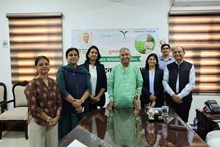





India's fertiliser sector set a clear direction for nutrient and food security as the Fertiliser Association of India (FAI) concluded its 62nd Annual Seminar 2026 in New Delhi. The three-day seminar was held under the theme "Securing Fertiliser Future for Sustainable Agriculture." The seminar brought together over 1,800 delegates, including senior government officials, scientists, 117 international representatives from about 26 countries, industry leaders and global technology suppliers. They discussed how to keep fertilisers available, affordable and sustainable amid global supply shocks and geopolitical uncertainty.
Addressing the event, Chief Guest, Shri Jagat Prakash Nadda, Hon'ble Union Minister of Chemicals & Fertilizers and Health & Family Welfare, said, “India has come through a difficult phase in fertiliser supply, and the government and industry overcame it together. I thank Hon’ble Prime Minister Shri Narendra Modi Ji for his leadership and the industry for its cooperation. Farmers received fertilisers on time, and prices were protected, with urea at ₹266.6 per bag and DAP subsidy around ₹3,000 per bag. Six new plants have come up over the last decade, six more are planned, and an investment of ₹54,000 crore is envisaged. Availability and affordability of fertilisers will continue to be maintained.”
Mr. Rajat Kumar Mishra, Secretary, Department of Fertilizers, Ministry of Chemicals and Fertilizers, Government of India, said, “India’s agricultural production has grown significantly over the years, driven by scientific interventions, industry capabilities and adoption by farmers. 87% of fertiliser buyers being small and marginal farmers, the fertiliser industry has a critical responsibility to ensure affordable, timely and reliable access to fertilisers. Strengthening supply chains and ensuring the timely delivery of subsidised fertilisers to intended beneficiaries through robust monitoring systems will be essential for safeguarding farmers’ interests and reinforcing India’s food security along with farmers' prosperity.”
Mr. S. Sankarasubramanian, Chairman, FAI, and MD & CEO, Coromandel International Ltd., said, “India is making steady progress towards Atma Nirbharta in fertilisers, supported by the Government’s strong policy commitment and investment push. The recently announced six new urea plants with capital outlay of Rs 54,000 crores, along with planned capacities in phosphatics and intermediates, represent an important step towards strengthening India’s fertiliser self-reliance. These initiatives will significantly enhance domestic availability and help shield our farmers from geopolitical uncertainties and global supply shocks, while subsidy support continues to ensure nutrient affordability. The FAI Annual Seminar 2026 provided a valuable platform for constructive dialogue between policymakers and industry on building self-sufficiency, strengthening food security, promoting sustainable manufacturing and responsible marketing, and creating robust supply chains for a more resilient fertiliser sector.
Dr. Suresh Kumar Chaudhari, Director General, FAI, said, "Agriculture drives roughly 18% of India's GDP, and fertilisers drive agriculture. But global uncertainty, regional conflicts and rising geopolitical tensions are putting that chain under strain. India still depends on imports, so we need sharper visibility on global markets and price trends to plan imports strategically. We must also build joint ventures and partnerships with resource-rich countries to secure supply and make India's fertiliser sector more resilient."
Four sessions, one national agenda
Session I: Fertiliser Policy for Nutrient Security. Chaired by Ms. Aparna S. Sharma, Additional Secretary, Department of Fertilizers.
Session II: Ensuring Food Security. Co-chaired by Dr. Trilochan Mohapatra, Chairperson, PPV&FRA, and Dr. M.L. Jat, Secretary (DARE) & Director General, ICAR.
Session III: Sustainable Fertiliser Production. Chaired by Mr. R.K. Chopra, Managing Director, KRIBHCO.
Session IV: Changing Paradigm in Fertiliser Marketing. Chaired by Mr. K.J. Patel, Managing Director, IFFCO.
Key takeaways
Self-reliance: Six new urea plants with a capital outlay of Rs 54,000 crore, plus planned phosphatic and intermediate capacities, will boost domestic availability and shield farmers from supply shocks.
Supply-chain resilience: Diversifying raw material sources globally, planning imports strategically and forming partnerships with resource-rich countries emerged as priorities.
Farmer-first delivery: Most of the fertiliser buyers being small and marginal farmers, the focus is on affordable, timely access and strong monitoring to ensure subsidised fertilisers reach the intended beneficiaries.
Green and sustainable shift: Deliberations covered the changing global policy environment for green fertilisers and the need for sustainable manufacturing and responsible marketing.
Knowledge releases: FAI released "Fertiliser Statistics 2025-26", "Specialty Fertiliser and Micronutrient Statistics 2025-26", "The Fertiliser (Control) Order 1985" and the compendium "Samriddh Dharti".
The seminar's message is clear. India's food security will depend on how well it builds domestic capacity, secures global supply and puts farmers first. With government and industry aligned, the sector is ready to move from dialogue to delivery and make India's fertiliser future secure, sustainable and self-reliant.
FAI also celebrated excellence across the sector through awards that recognised achievements in production performance, technical innovation, safety, environmental protection, digital farming, bio and organic fertiliser promotion, micronutrient marketing, farm technology transfer and creative communication.
About The Fertiliser Association of India (FAI)
The Fertiliser Association of India (FAI), established in 1955, is a premier non-profit organisation which represents the ecosystem stakeholders such as fertiliser manufacturers, importers, technology providers, equipment suppliers, and researchers across the country. With a mission to enhance the operational efficiency of the fertiliser sector and promote balanced and scientific fertilisation, it plays a crucial role in strengthening India’s agricultural productivity and food security. It also serves as a bridge between industry and government and facilitates dialogues between them while offering policy inputs. With its four regional offices, technical divisions, training programs, specialised studies, and international collaborations, FAI contributes immensely to continuous improvement in production, distribution, sustainability, and fertiliser use efficiency in the country. Most notably, it also publishes widely respected journals and research materials, which help shape policy and industry decisions.